









 Two Curves, One Future: Demographics Across Africa and Asia
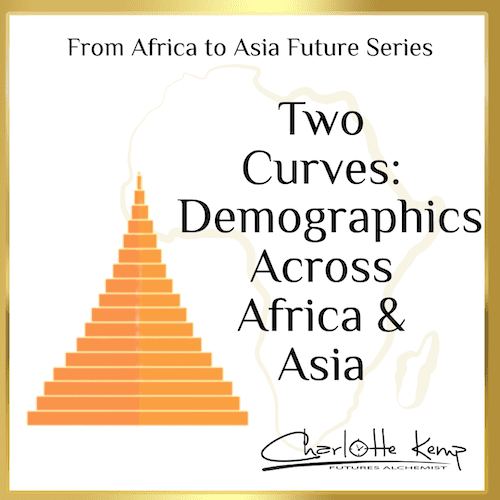
 Two Curves, One Future: Demographics Across Africa and Asia
Purpose
To help leaders understand how contrasting demographic trajectories in Africa and Asia will reshape markets, workforces, leadership, and long-term strategy.
Why this matters now
Asia is confronting population aging, shrinking workforces, and rising dependency ratios.
Africa is facing rapid population growth, youth unemployment pressures, and massive urbanisation.
These trends are not isolated and understanding the contrast between them gives us strategic insights.
Core insight
Demographics are not destiny. Africa and Asia may sit on opposite demographic curves, yet their futures are increasingly linked through talent flows, markets, technology, and capital.
Outline
- The global demographic map – What is changing, where, and how fast
- Asia’s demographic inflection point – Aging, care economies, productivity pressures
- Africa’s youth bulge – Opportunity, risk, and the urgency of absorption
- Where the curves intersect – Talent, migration, remote work, consumption, innovation
- Strategic implications for leaders – Workforce planning, product design, policy, partnerships
- Preferred futures – What proactive leadership looks like
Audience take-aways
- A clearer understanding of long-term demographic risk and opportunity
- Strategic questions to ask about talent, growth, and sustainability
- A Global South lens rarely applied to demographic planning
Ideal for
Boards, strategy teams, HR & L&D leaders, policymakers, investors
Inventing Under Pressure: Innovation Lessons from Africa and Asia
 Inventing Under Pressure: Innovation Lessons from Africa and Asia
Purpose
To explore how innovation emerges under pressure, and why constraint is often the birthplace of breakthrough.
Why this matters now
As global systems become more volatile, scarcity is no longer an exception — it is becoming the norm. Organisations need to innovate without assuming abundance.
Core insight
Innovation is not about resources. Innovation comes from intent, context, and design.
Africa’s experience with leapfrogging and Asia’s experience with scale reveal complementary approaches to innovation in uncertain environments.
Outline
- The myth of innovation through abundance
- Africa’s constraint-driven innovation stories – Financial inclusion, informal systems, leapfrogging
- Asia’s scale-driven innovation models – Infrastructure, platforms, long-term planning
- What each region gets wrong – Blind spots created by success
- Hybrid innovation futures – Where constraint meets coordination
- Leadership lessons for uncertain times
Audience take-aways
- New ways to think about innovation beyond R&D and tech
- Practical examples from non-Western contexts
- Questions to reshape innovation strategy under pressure
Ideal for
Innovation leaders, executives, entrepreneurs, government agencies, strategy teams
Who Governs the Future? Trust, Legitimacy and Leadership
 Who Governs the Future? Trust, Legitimacy and Leadership
Purpose
To examine how trust, legitimacy, and governance shape futures — and what happens when social contracts begin to fray.
Why this matters now
Trust is declining globally, in institutions, leadership, systems, and even technology. Without trust, strategy fails.
Africa and Asia offer contrasting but deeply instructive governance experiences.
Core insight
The future is governed as much by trust as by policy.
Formal systems, informal networks, culture, and power dynamics all shape how futures actually unfold — not just how they are planned.
Outline
- Why governance matters to the future
- Asia’s strength in formal systems – Planning, coordination, institutional capacity
- Africa’s parallel systems – Informality, networks, adaptive governance
- Where trust breaks down – Loyalty, elites, ethics, unintended consequences
- Leadership in low- and high-trust environments
- Designing resilient social contracts
Audience take-aways
- A deeper understanding of ethical and governance risk
- Tools to recognise early warning signs of trust erosion
- Insight into navigating complexity with legitimacy
Ideal for
Boards, senior executives, public sector leaders, ESG and ethics committees
The Human Equation: Talent and Work Across Africa and Asia
 The Human Equation: Talent and Work Across Africa and Asia
Purpose
To help organisations rethink talent, skills, and work in a world of demographic imbalance, technological disruption, and shifting expectations.
Why this matters now
- Asia faces growing labour shortages.
- Africa faces a surplus of young talent struggling to find opportunity.
- The future of work will depend on how these realities connect, not how they compete.
Core insight
The future workforce will be distributed, hybrid, and global, but only if leaders design for it intentionally.
Africa and Asia are part of the same evolving talent system.
Outline
- The changing nature of work – Automation, AI, remote work, skills disruption
- Asia’s workforce pressures – Aging, care, productivity, leadership pipelines
- Africa’s talent paradox – Youth, education, underemployment
- New models of work and collaboration –
- Remote teams, digital labour, cross-border ecosystems
- Strategic implications for organisations – Skills, culture, leadership, inclusion
- Designing preferred work futures
Audience take-aways
- Insight into emerging workforce models
- Strategic questions for talent planning
- A broader lens on human capital futures
Ideal for
HR & L&D leaders, CEOs, education institutions, government agencies, multinationals